Is Your Work Experience Too Short, Too Long or Just Right for ISB? The Career-Stage Advantage

Introduction: Is There a Perfect Time to Apply to ISB?
You have been working for two years. Should you apply to the Indian School of Business (ISB) now, or spend another year building your profile?
Perhaps you have five years of experience but are concerned that your career progression has been slower than expected. Or maybe you have eight years of experience and wonder whether waiting longer will strengthen your application, or simply delay your next career move.
These are important questions because the right time to apply to ISB is not determined by the number of years you have worked alone. Eligibility establishes whether you can apply. The quality of your professional journey helps explain whether you are ready to make the most of the programme and contribute meaningfully to the classroom.
Two applicants with the same number of years of experience can present very different profiles. One may have taken ownership of challenging projects, influenced decisions, and learned from setbacks. The other may have spent the same period performing similar responsibilities without much opportunity to demonstrate growth.
Neither situation should be judged by tenure alone.
If you are evaluating your readiness for the ISB Post Graduate Programme in Management (PGP), this guide will help you understand the official work experience requirements, identify the evidence that matters, and decide whether applying now or waiting makes strategic sense.
1. What Are the ISB PGP Work Experience Requirements?
Before assessing your profile, distinguish between the programme's eligibility requirements and the broader qualities considered during admission.
According to ISB's PGP eligibility requirements, the PGP is designed for applicants with at least 24 months of full-time work experience. ISB specifies that candidates should have this experience before enrolment; the precise date used to calculate eligibility should be checked against the current application cycle's instructions.
Other core requirements include a recognised bachelor's degree or equivalent qualification and a valid GMAT or GRE score from an accepted test-centre format. ISB does not specify a minimum undergraduate percentage or CGPA, nor a minimum GMAT or GRE score for applying, although academic capability and test performance form part of the overall evaluation.
The admissions process considers multiple components, including academic credentials, test scores, professional experience, essays, extracurricular activities, awards, and recommendations. ISB describes its process as a holistic assessment of the applicant's strengths and potential contribution.
You can review the current details directly on the eligibility and requirements page and the PGP FAQ. Our ISB PGP overview is a useful companion while you compare those rules with your own timeline.
Important: Do not calculate eligibility using a generic rule from an older blog or discussion forum. Work experience cut-off dates and other application instructions can vary by intake. Verify the applicable dates for the class you intend to join.
Does ISB count every type of work experience?
Not necessarily. ISB's published PGP guidance specifies full-time professional experience. Part-time work and CA articleship, for example, are not treated as qualifying full-time work experience under the programme's FAQ, although relevant activities may still add context to an applicant's background.
If you have worked in a family business, served in the armed forces, changed industries, or held several roles within one organisation, read the official guidance carefully and provide accurate supporting documentation. ISB notes that the nature and quality of responsibilities matter when assessing professional experience.
Meeting the minimum requirement means you may be eligible to apply. It does not, by itself, establish that your application will be competitive.
2. Is Two Years of Experience Enough for ISB?
Two years can be enough to meet the minimum eligibility requirement, but the more useful question is what you have been able to demonstrate during those two years.
An applicant with relatively short experience may already have evidence of initiative, analytical thinking, ownership, and learning. Another applicant with the same tenure may have had fewer opportunities to take responsibility. Both need to assess their profiles honestly rather than assume that the number of months tells the whole story.
Consider two illustrative applicants.
Applicant A: Two years of experience
- Took ownership of a reporting process that repeatedly missed deadlines.
- Identified the cause of delays and proposed a practical change.
- Worked with colleagues to implement the change.
- Can explain what worked, what did not, and what they would do differently.
Applicant B: Two years of experience
- Completed assigned tasks reliably.
- Has developed technical skills and learned the organisation's processes.
- Has had limited exposure to independent decisions or cross-functional projects.
- Has not yet identified clear examples of initiative beyond routine responsibilities.
These are not predictions of admission outcomes. They illustrate why applicants with the same tenure can have different amounts of evidence to present.
Applicant B may still have a worthwhile application story, particularly if their role offers limited autonomy. However, they may benefit from seeking more ownership, pursuing a challenging project, or developing a clearer account of their professional growth before applying.
Questions to ask yourself before applying early
- Can I explain what I have contributed beyond my assigned responsibilities?
- Have I solved a problem, improved a process, or helped a team make a better decision?
- Can I show how my responsibilities or judgment have developed?
- Do I understand why I need management education at this stage?
- Can I explain my career goals without relying on generic statements about leadership or career acceleration?
If you can answer these questions with specific, credible examples, your relatively short experience may still provide meaningful material for your application.
If most answers remain vague, consider whether another period of purposeful professional development would strengthen your story. Weak or generic goals are also one of the common ISB rejection reasons worth reviewing before you draft.
3. Is More Work Experience Always Better?
It is tempting to assume that five or six years of experience must be stronger than two or three. More time at work can create opportunities to develop deeper expertise, manage complex projects, mentor colleagues, and understand organisational decisions.
However, more experience is valuable when it adds depth, responsibility, perspective, or impact, not simply when it increases the number of years on your résumé.
Imagine an applicant with six years of experience who has repeatedly performed similar tasks without expanding their responsibilities. Compare that with an applicant who has four years of experience and has moved from executing individual tasks to coordinating stakeholders, handling difficult decisions, and owning a project from planning through delivery.
The second applicant may have a clearer progression story, even with fewer years of experience. That does not mean the applicant with six years is less competitive; their experience may reveal strengths that are not obvious from a job title alone.
The lesson is to assess what your experience demonstrates rather than compare yourself with an imagined ideal number of years.
What should your career progression demonstrate?
Look beyond promotions and changes in designation. Consider whether your experience shows progression in any of these areas:
- Scope: Have you moved from completing tasks to owning a process, project, or business outcome?
- Complexity: Have you handled more ambiguous problems or decisions with competing priorities?
- Influence: Have you worked with stakeholders, persuaded others, or helped resolve disagreements?
- Accountability: Have you become more responsible for the quality, delivery, or consequences of your work?
- Learning: Can you identify assumptions you changed, skills you developed, or mistakes that influenced your approach?
- Perspective: Do you understand your organisation, industry, customers, or business challenges more deeply than you did earlier in your career?
Not every applicant will demonstrate all six areas. Your task is to identify the strongest and most authentic evidence from your own professional journey.
4. The Career-Stage Advantage: What Can Different Applicants Emphasise?
There is no universal number of years at which every candidate becomes ready for ISB. However, thinking in terms of career stages can help you identify what to look for in your own profile.
Early career
0–2 years: building evidence of ownership
At the beginning of your career, your responsibilities may be narrow and your authority limited. You may not manage people or make major strategic decisions. That does not mean your experience lacks value.
Mid career
3–6 years: broader responsibility
With more experience, you may have led projects, coordinated teams, influenced stakeholders, or taken responsibility for measurable outcomes.
Experienced
7+ years: explaining the opportunity cost
A full-time, one-year programme becomes more consequential. The question is whether the programme fits the next stage of your career.
Early career: Building evidence of ownership
Look for examples in which you took initiative, identified an issue, improved a process, helped a team, or used analysis to support a decision. Be specific about what you did and what you learned.
At this stage, you should also be able to explain why management education is relevant now. If your motivation is based only on wanting a better salary or a more prestigious job title, spend time understanding what you actually want to learn and which career direction you want to pursue. Early-career applicants comparing programmes can also review PGP YL, which is designed for a different experience range from the flagship PGP.
Mid-career: Demonstrating broader responsibility
The challenge is to distinguish your own contribution from the work of the wider team. Explain the context, your decisions, the obstacles you faced, and the outcome you helped achieve.
You should also be able to articulate why this is the right point to move towards your next goal. For example, you may need broader business knowledge to transition from a specialist function into general management, or you may want to develop the skills required to take on larger responsibilities.
More experienced applicants: Explaining the opportunity cost
As your career advances, the decision to pursue a full-time, one-year programme becomes more consequential. You may be leaving a role with greater responsibility, delaying a promotion, stepping away from a growing business, or taking time out of a career that is already progressing.
The relevant question is not whether you have "too much" experience. It is whether the programme fits the next stage of your career and whether the benefits you expect justify the financial, professional, and personal trade-offs.
Consider the capabilities you still need to build, the opportunities you want to pursue after the programme, and whether a full-time programme is the most appropriate route for those goals.
Do not delay simply to accumulate more years. Equally, do not apply just because you have reached the minimum eligibility threshold. Make the decision based on readiness and purpose.
5. Five Signs You May Be Ready to Apply to ISB
Years of experience alone cannot answer the question, but the following indicators can help you assess your readiness.
Sign 1: You can explain your contribution clearly
You can describe specific projects, decisions, or improvements and distinguish your role from the team's overall work. You do not need to claim sole credit for collaborative achievements.
Sign 2: You have learned from real professional situations
You can discuss a difficult decision, a setback, a disagreement, or an unexpected outcome and explain how it influenced your approach. Your reflection demonstrates growth rather than simply ending with "I learned teamwork."
Sign 3: Your next career step is reasonably clear
You may not know the exact role or employer you will pursue after ISB. However, you should understand the direction you want to explore and why your current capabilities are insufficient for that next step.
Sign 4: You can explain why ISB is relevant
Your reasons go beyond rankings and reputation. You can connect the programme's learning environment, curriculum, and opportunities to your actual development needs. Use the official PGP curriculum and the ISB PGP page to identify relevant learning opportunities.
Sign 5: Your wider application supports your story
Your academic record, test score, recommendations, essays, and professional experience should collectively help the admissions committee understand your capabilities and potential. A strength in one area does not automatically remove the need to prepare the others.
These signs are a practical self-assessment framework, not an official ISB scoring system or a guarantee of admission.
6. When Should You Wait Another Year Before Applying?
Waiting can be a strategic choice, but only if you use the additional time purposefully.
You may benefit from waiting if:
- You are still short of the programme's minimum qualifying work experience for your intended intake.
- You have limited examples of initiative or professional growth and a realistic opportunity to gain more responsibility.
- Your career goals are unclear, making it difficult to explain why you want to pursue management education now.
- You need additional time to prepare for the required GMAT or GRE, strengthen your academic readiness, or organise your application documents.
- Your finances, personal circumstances, or career commitments make immediate enrolment impractical.
If you decide to wait, create a plan for the period rather than treating another year as an automatic improvement.
For example, seek responsibility for a project, ask to participate in a cross-functional initiative, develop a skill linked to your target role, or take ownership of a measurable business problem. Keep track of your decisions, actions, and outcomes so that you can later explain the experience accurately.
Waiting without a development plan may add tenure without adding much to your application. Waiting with a clear purpose can help you build stronger evidence and make a more informed career decision.
7. How to Assess Your ISB Work Experience Before Applying
Use the following table to evaluate your professional readiness. It is a reflection tool, not an official ISB admissions rubric.
| Area to assess | Questions to ask | Evidence to identify |
|---|---|---|
| Eligibility | Will I meet the applicable work experience requirement for my intended intake? | Employment dates and supporting documents |
| Ownership | What have I taken responsibility for beyond routine execution? | Projects, processes, decisions, or initiatives |
| Impact | What changed because of my contribution? | Verifiable outcomes, improvements, or stakeholder feedback |
| Leadership potential | How have I influenced, supported, or coordinated others? | Teamwork, conflict resolution, mentoring, or stakeholder management |
| Learning | What has changed in how I approach work? | Lessons from setbacks, feedback, or difficult decisions |
| Career direction | Why do I want to pursue management education now? | A clear link between past experience, skill gaps, and future goals |
| Application readiness | Can the rest of my application support my story? | Essays, test score, academics, recommendations, and documented achievements |
After completing the assessment, look for gaps rather than aiming for a perfect score. A gap may indicate that you need more professional exposure, a clearer career goal, stronger examples, or better preparation of the application itself.
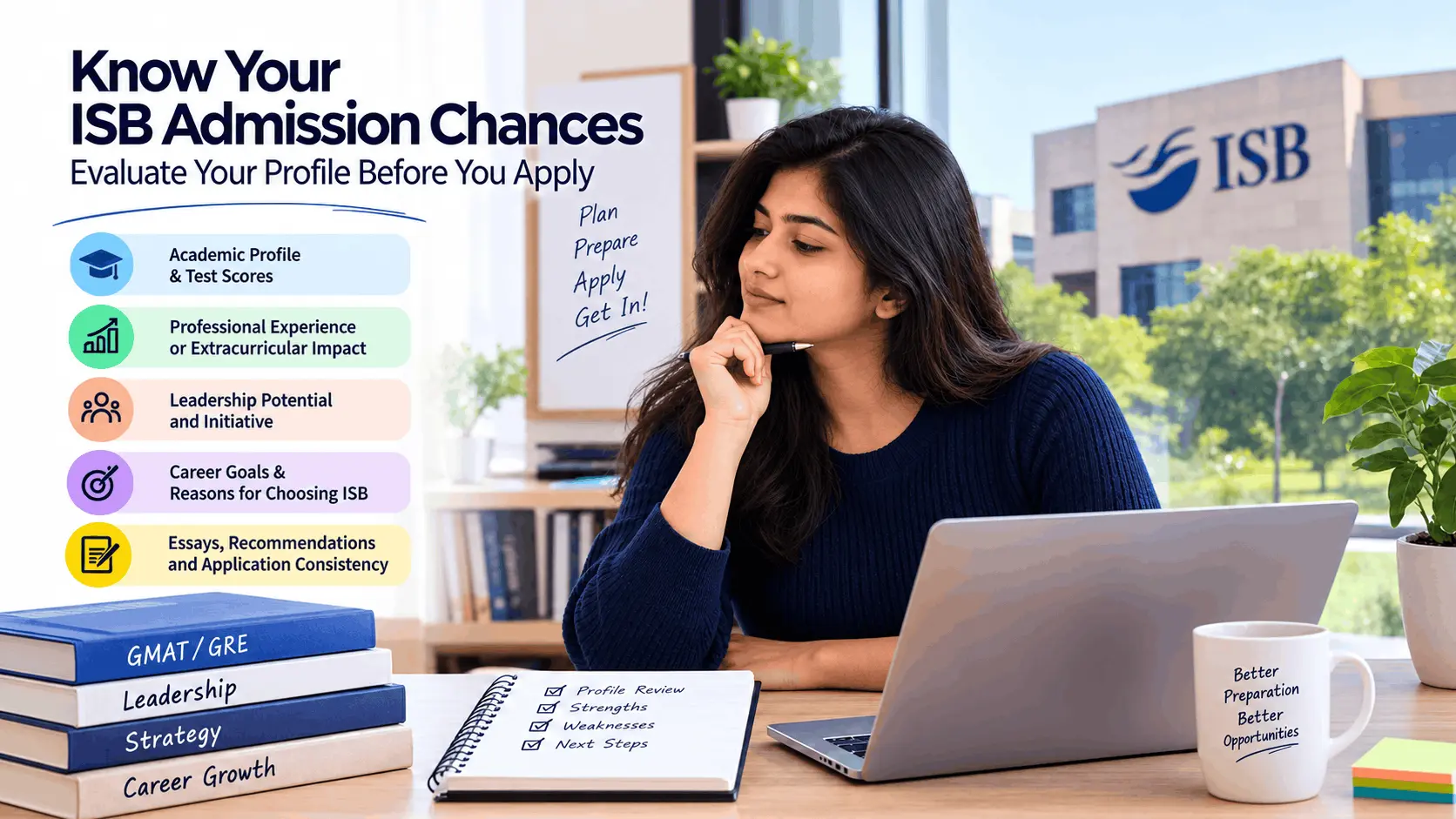
For a more detailed evaluation of how your academics, professional experience, achievements, and goals fit together, read what actually makes an average profile stand out and our guide on ISB admission chances and profile evaluation.
This is a useful next step if you are trying to understand not just whether you meet the work experience requirement, but how your professional journey fits into the broader application.
8. Common Myths About ISB Admission Work Experience
Myth 1: "I have the minimum required experience, so I am ready to apply."
Reality: Minimum experience establishes eligibility, not admission readiness. You still need to prepare the other components of your application and explain what you bring to the programme.
Myth 2: "Applicants with more years of experience always have an advantage."
Reality: Tenure alone does not establish the quality of an applicant's contribution, judgment, learning, or future goals. More experience may create more opportunities to demonstrate these qualities, but it does not guarantee a stronger application.
Myth 3: "I need a managerial title to demonstrate leadership."
Reality: Leadership potential can be demonstrated through initiative, collaboration, influencing others, problem-solving, and accountability. Formal people-management responsibility is only one possible source of evidence.
Myth 4: "If I wait another year, my chances will automatically improve."
Reality: An additional year helps only if it adds relevant experience, skills, clarity, or stronger evidence. The decision to wait should be based on what you can realistically achieve during that time.
Myth 5: "My career has not followed a straight line, so my profile is weak."
Reality: Career changes, varied roles, and periods of uncertainty are not automatically weaknesses. What matters is whether you can explain your decisions, the value of your experiences, and the direction you want to take next.
Your application should help the admissions committee understand your journey, not force your journey into an artificial, perfectly linear narrative.
9. How ISB Admit Can Help You Decide When to Apply
Deciding when to apply to ISB involves more than checking whether you have completed two years of work experience. You need to understand the strengths of your professional journey, identify gaps in your application, and determine whether your next career step aligns with the value of a full-time management programme.
A structured profile evaluation can help you examine:
- Work experience and career progression: Whether your responsibilities, achievements, and learning demonstrate meaningful professional development.
- Leadership and impact: How effectively you communicate your contribution to projects, teams, and organisational outcomes.
- Career goals: Whether your reasons for pursuing an MBA are credible and connected to your past experience.
- Application strengths and gaps: How your professional experience fits with your academics, test score, essays, and recommendations.
- Application timing: Whether you appear ready to apply for your intended intake or would benefit from a targeted development plan before applying.
At ISB Admit, the goal of profile evaluation and application guidance is to help applicants make informed decisions and present their genuine experiences clearly. No assessment can guarantee admission, but a careful review can help you approach the process with greater clarity.
Not sure whether you should apply to ISB this year or wait?
Start with ISB Admit to explore application guidance, or contact us to discuss a profile evaluation. You can use the review to identify the strongest parts of your professional story, the gaps that deserve attention, and the next steps that make sense for your goals.
Frequently Asked Questions About ISB PGP Work Experience
1. How many years of work experience are required for ISB PGP?
ISB's published PGP eligibility requirements specify at least 24 months of full-time work experience. Applicants should verify the exact calculation date and requirements for their intended intake on the official eligibility page.
2. Can I apply to ISB with two years of work experience?
You may meet the minimum experience requirement if you have the required qualifying full-time experience by the applicable cut-off. However, eligibility does not guarantee admission. You should also consider the strength of your professional contributions, career goals, academic readiness, test score, essays, and recommendations.
3. Does ISB prefer applicants with more work experience?
Do not assume that more years automatically mean a stronger application. ISB evaluates professional experience as part of a broader admissions process. The responsibilities you have handled, your impact, your learning, and your potential contribution all help provide context for your experience.
4. Is part-time work counted towards ISB PGP work experience?
ISB's PGP FAQ states that qualifying work experience should be full-time and that part-time work is not counted as such. Review the PGP FAQ for guidance on specific employment situations.
5. Is a managerial designation necessary for ISB admission?
A managerial title is not the only way to demonstrate leadership potential. Applicants can use examples of initiative, ownership, teamwork, problem-solving, and influencing others. The important thing is to explain the situation and your contribution with credible evidence.
6. Should I wait another year before applying to ISB?
Consider waiting if you need to meet the eligibility requirement, strengthen your professional evidence, clarify your career goals, improve application readiness, or address practical constraints. If you wait, identify specific goals for that period so the additional time contributes to your development.
7. Can I apply to ISB if I have a career gap or have changed jobs frequently?
A career gap or multiple job changes does not automatically determine the outcome of an application. Explain your transitions accurately, provide the relevant context, and show what you learned or achieved across your roles. Ensure your employment history and supporting documents are consistent.
8. What should I focus on besides work experience for ISB admission?
Review all current application requirements, including academics, accepted test scores, essays, recommendations, awards, and other relevant achievements. Your application should present a coherent picture of your abilities, motivations, professional development, and future direction.
Final Takeaway: Apply When Your Experience Tells a Meaningful Story
There is no universal career stage that guarantees admission to ISB. The minimum work experience requirement tells you when you may be eligible to apply; it does not tell you whether you have made the most of your professional journey or whether this is the right time for your next move.
If you are early in your career, focus on demonstrating initiative, learning, and ownership. If you have more experience, explain how your responsibilities and perspective have evolved, and why management education fits your next career step.
Above all, avoid waiting simply to accumulate years or applying simply because you meet the minimum requirement.
Assess your eligibility, examine your evidence, clarify your goals, and make the decision that best supports your career.
If you need help understanding where your profile stands, request a profile evaluation.